
Landscape Drawing with Graphite

Lessons
About This Lesson Series...
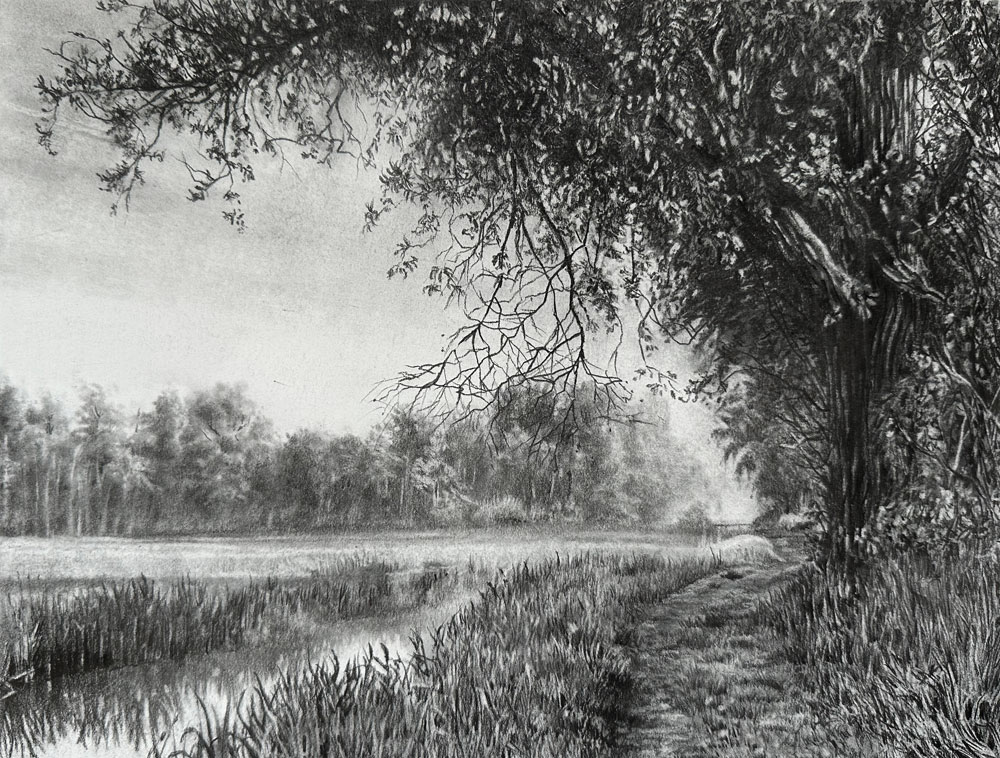
The Graphite Landscape Drawing class is a comprehensive study in creating realistic and expressive landscapes using graphite pencils. This lesson focuses on the essential drawing skills needed to capture the natural world convincingly, emphasizing observation, value control, and thoughtful mark-making. Through a complete start-to-finish demonstration, you’ll learn how a simple drawing medium can produce rich depth, atmosphere, and realism.
Building a Strong Foundation
The class begins by establishing a solid foundation for the drawing. You’ll learn how to approach a landscape subject with clarity, breaking complex scenes into manageable shapes and forms. Emphasis is placed on proportion, placement, and perspective so the composition feels balanced and believable. This careful planning stage ensures that every decision made later in the drawing supports the overall image.
Understanding Value in Landscape Drawing
Value plays a critical role in landscape drawing, and this class devotes significant attention to developing accurate light and shadow. You’ll explore how a full range of values—from the lightest highlights to the darkest shadows—creates depth and dimension. The lesson demonstrates how to simplify value relationships and gradually refine them to suggest distance, form, and atmosphere within the scene.
Creating Depth and Space
One of the key challenges in landscape drawing is creating the illusion of depth on a flat surface. In this class, you’ll learn how to separate foreground, middle ground, and background through careful control of value, edge quality, and detail. Softer contrasts and lighter values are used to push elements into the distance, while stronger contrasts bring forms forward, resulting in a convincing sense of space.
Developing Texture with Graphite
Graphite is an incredibly versatile medium, and this lesson shows you how to use it to suggest a wide variety of natural textures. You’ll explore mark-making techniques that describe trees, rocks, ground planes, and sky without overworking the drawing. Instead of relying on excessive detail, the class demonstrates how thoughtful strokes and value transitions can imply texture efficiently and effectively.
Using Line and Edges Effectively
While value is the primary focus, line and edges also play an important role in the drawing. You’ll learn when to use defined edges and when to soften them to enhance realism. The class explains how selective use of line can guide the viewer’s eye through the composition and reinforce the structure of the landscape without making the drawing feel rigid or outlined.
Refining the Drawing Step by Step
As the drawing progresses, you’ll see how layers of graphite are gradually built up to refine forms and strengthen contrasts. The instructor demonstrates how to work patiently and deliberately, avoiding common mistakes such as over-blending or flattening values. This methodical approach helps maintain clarity while allowing the drawing to develop naturally.
Materials and Techniques
The class also discusses the materials used for graphite landscape drawing, including pencil selection, paper choices, and blending tools. You’ll gain insight into how different grades of graphite affect value and texture, and how the surface of the paper influences the final result. These practical considerations help you get the most out of your tools and apply the techniques confidently in future drawings.
A Valuable Skill-Building Experience
By the end of the Graphite Landscape Drawing class, you’ll have completed a finished landscape drawing while developing a deeper understanding of how to use graphite effectively. The skills taught in this lesson—observation, value control, texture, and depth—are fundamental to all forms of drawing. This class serves as a strong stepping stone for artists who want to improve their realism and confidence in drawing landscapes.
Specific Lessons
Lesson 1 (1:08:14)
In lesson one, we discuss the materials and surface and paint in the basic shapes with graphite powder.
Lesson 2 (1:07:58)
In lesson two, we begin the drawing the details of the leaves and branches of the large tree.
Lesson 3 (1:13:32)
In lesson three, we continue drawing the small leaves on the tree.
Lesson 4 (1:06:18)
In lesson four, we begin working our way down the trunk of the dominant tree, adding textures.
Lesson 5 (1:06:10)
In lesson five, we begin working on the distant trees along the horizon.
Lesson 6 (1:10:23)
In lesson six, we continue work on the distant line of trees over the field.
Lesson 7 (1:12:33)
In lesson seven, we complete the distant trees and begin work on the grassy bank and water reflections.
Lesson 8 (1:08:33)
In lesson eight, we move down to the grasses in the foreground.
Lesson 9 (59:55)
In lesson nine, we draw the path in the foreground.
Lesson 10 (1:20:53)
In lesson ten, we complete the drawing.
Resources for this Lesson...
Distributing any content downloaded from this site is strictly prohibited and against the terms and conditions of use.
References
Here's what you'll need...
- Stonehenge Polar White Drawing Paper
- Powdered Graphite
- Graphite Pencils
- Soft Mop Brush
- Kneaded Eraser
- Vinyl Erasers
(Disclosure: Links to art materials are affiliate links which means we make a small commission if you purchase at no additional cost to you.)

Founder of The Virtual Instructor, artist and teacher. Matt makes learning art easy to understand and enjoyable.
Hello
CAN YOU TELL ME HOW TO CLEAN THE BLENDING STUMP%?
Hi Marie,
Some folks like to use a sanding pad to clean the blending stumps. I just prefer to buy a bunch and use them as necessary. They are very cheap to purchase.
Thank you Matt. This is very helpful.
Hahaha! Thank you Matt… I stopped buying so many when my husband saw me throwing them away 🤪. I have a frugal Mr. So thankful for your classes🙌
Yay! Matt #8 ready to watch again after live…You are getting faster even though you are doing homework now I know on this after not asking us this time!! Ha Ha !
Way to go Matt!
love this one and both of you guys too!
Therese
Sandpaper
I AM 77 AND JUST STARTED TO LEARNING TO DRAW. WHILE YOU SAY LEARNING TO DRAW IS PRACTICE, BUT IT SEEMS THAT THERE MUST BE SOME NATURAL ABILITY NEEDED. HOW LONG, JUST FOR GENERAL INFORMATION, WILL IT TAKE FOR ME TO BE ABLE TO DO THIS PICTURE. i PRACTICE EVERY DAY AND I HAVE MADE SOME PROGRESS, BUT……
Dear Robert,
Though your question is addressed to Matt, I would like to answer just in case he doesn’t see your question.
If you like, join us on live lessons, so you can directly ask him.
If I quote correctly, than Matt would say: There is no such thing as talent. Talent is the result of practice.
As a start, I would suggest to start with the course “25 days of better drawing”. It gives you the very first steps and encouragement to begin with. “Subjects with pen and ink” is also a course I would highl recommend.
I found it easier to learn and practice whith non-colored mediums such as graphite, charcoal and black ink. Limitting the color palette is always helpful as a beginner (and still later on).
Sketch as often as possible. Look around you and think about how you would draw things you see, if you were drawing them. Watch out for shapes and forms in your environment. Try to describe the colors and values you see.
In a nutshell: practice to see as an artist.
You can also use the forum to ask any question. There is no stupid one and the commuis a big family (at least for me).
It’s never too late to start a new hobby,
Buddy
I agree with Buddy,
Yes starting is the key… Matt and Ashley will teach you everything you need to know about art and will laugh out loud with them. They are truly friendly characters and their friendship with each other only adds to the fun!
Join and enjoy!
Therese
hello robert, im 81 and just started a few years ago after i retired. Enjoy the journey ,follow along with each lesson as I’ve done for a few years now and one day someone will look over your shoulder and say ,wow , that’s amazing. you will look at it and see all that’s wrong with it. But think of all the hours of enjoyment and using the forum on this site that you may have wasted in front of a tv screen . Im still trying to do portraits of family and friends ,every time i do one its different then the last. looks like Buddy has some good advise that he posted. im also teaching myself to read music although i dont expect to ever be able to actually play an instrument ,well who knows, see you on the forum>>>>>>>>>>>>>>>>> tom
I’ve been doing it just three years& just turned 74, Robert and it was my first attempt at lessons and things are progressing well. You’ll see things improve as you take the lessons in the order, they appeal to you! Matt and Ashley go slow and thorough and you’ll love it, I’m sure!
Therese
Hi, I’ve been following the classes here for years but never live, just watching the recordings. Even when I lived in the United States (in California) and certainly now that I’m in Israel, there are bigger time differences. This lesson you managed to really make me laugh, I’m drawing with my headphones in the kitchen and can’t stop laughing. I loved your message at the end – to be a light to the world. see you next lesson
Hi Matt I am a 9 year old artist in training and a big fan of your lessons 🙂 although I often feel I am cheating in a way when I use wonderful tutorials like these which is rubbish because I know I’m just learning. I never get to watch live lessons live as it is way past my bedtime but I enjoy following along afterwards!
I’m glad you realize that it’s not cheating it’s learning!
Every artist, or the musician or painter or sculpture, or writer, takes classes and learns from others. Smart nine-year-old to be taking classes online!
Hi, I saw the most recent Gettin Sketchy… welcome back. ☺️Hope you had a great time with your family. Did I miss the Lesson 5 of the Graphite Landscape Drawing?
Five is recorded but six is not yet recorded but will be soon I’m sure!
I just started and I’m learning so much! Love it
Hello guys I am new to this art community. I have been watching Matt and Ashley for years now. I always knew I love to draw. During the pandemic I started to get reaquitted with my artwork. I am amazed at how far I have come thus far with my artwork. I will be posting some of my work for critiques for improvements please be kind.
W. Haynes
I’m sorry, but I am a little undereducated with respect to the computer. Can you tell me where are the links to the material needed for this course.
Hi Leonard,
The materials are listed under the Materials tab under the video. These are not links – just a list.
Hi Matt
That I’m aware of, but you mention that we can purchase them through you. Is there a link or site that we can go to?
Hi Matt & Ashley
I am new to the Virtual Instructor and have started with this class. Where can i access the E Books for it please ?
Hi Roy,
This series is considered a class. The courses include ebooks.
Hi Matt & Ashley,
I just completed the Landscape drawing with graphite and I’m very pleased with the way it turned out, especially as a first attempt. If I wanted to frame it, what is the best process to follow? Should I use some sort of spray to fix the graphite, or just frame it, as is?
Thanks,
Len
Hi Leonard,
I’m not a fan of fixative, so I never use it. Just be sure to matte the work so that it sits with a little space between the glass and the surface of the artwork. Most higher quality mattes will achieve this. I hope this helps.
Hi Matt, I have pastelmat, uart 800, canson velvet, and luxarchival paper. Which would be closest to the Stonehenge paper you are using?
Love the lesson. Just out of interest, what do you tape your paper to?
I use drawing boards and adhere the drawings to these boards.
Thank you for getting back to me.