
Subjects with Pen and Ink: Animals

Course Curriculum
Lesson Description
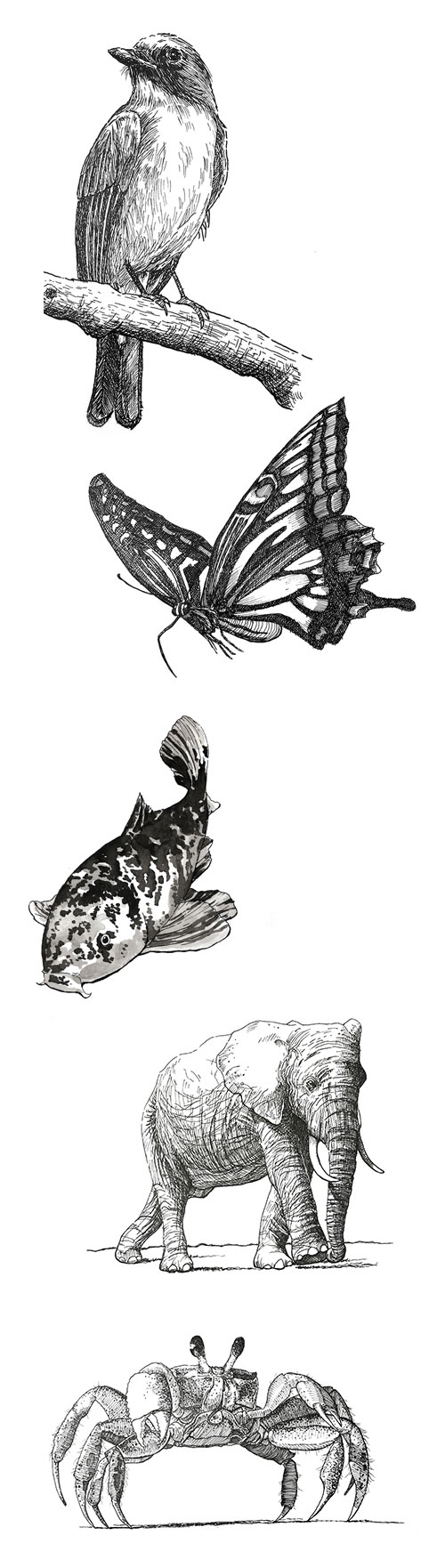
This lesson series is part of the larger "Subjects with Pen and Ink" course, offering step-by-step instruction on drawing a variety of animal subjects using traditional pen and ink techniques. Across this series, you’ll create detailed illustrations of a bird, a butterfly, a fish (koi), an elephant, and a crab, learning how to use line work, value, texture, and ink wash to bring each creature to life on paper.
Materials and Pen & Ink Basics
Before jumping into individual subjects, the series familiarizes students with essential materials and tools, including technical drawing pens, dip or nib pens with bottled ink, smooth Bristol paper, and, when needed, ink wash applied with a brush. The instructor also reviews foundational techniques like hatching, cross-hatching, and ink wash application to create value and form. Mastery of these tools and techniques sets the stage for success in each drawing.
Bird and Butterfly Lessons
The first two lessons focus on drawing a bird and a butterfly. With the bird lesson, students use nib pens and cross-hatching to define feathers, contours, and fine details, capturing both structure and texture. The butterfly lesson emphasizes delicate line work and careful value variation to suggest the intricate patterns of wings, helping artists refine precision and control.
Koi Fish with Ink Wash
In the koi fish lesson, students are introduced to combining pen and ink with ink wash for fluid value transitions. This lesson demonstrates how to suggest smooth scales and water reflections, using ink wash to deepen tonal contrast and enhance the illusion of form. Techniques shown here help build confidence in blending line work with brush-applied inks.
Detailed Drawing of an Elephant
The elephant lesson allows students to practice large forms and textured surfaces. Using technical drawing pens, the instructor demonstrates how to render thick skin folds, subtle shadow planes, and strong value contrasts. This subject challenges students to observe and translate complex value shifts into cohesive ink work.
Crab Illustration
The final lesson in the series focuses on drawing a crab. Students use technical pens to depict the crab’s segmented shell, varied textures, and cast shadows. This lesson reinforces how varied line quality and thoughtful hatching can communicate surface differences and depth.
Enhancing Pen & Ink Confidence
By completing the "Animals" lesson series, students gain practical experience in rendering diverse animal subjects with pen and ink. Through systematic exploration of line techniques, value control, and subtle use of ink wash, artists build confidence and expand their expressive capabilities with this versatile medium.
Specific Lessons
Lesson 17 - Bird
In lesson seventeen, we use nib (or dip) pens and cross hatching to create a drawing of a bird on smooth Bristol paper.
Lesson 18 - Butterfly
In lesson eighteen, we use technical drawing pens and cross hatching to create a drawing of a butterfly.
Lesson 19 - Koi
In lesson nineteen, we use ink wash and nib pens to create a drawing of a Koi fish.
Lesson 20 - Elephant
In lesson twenty, we use technical drawing pens to create a drawing of an elephant.
Lesson 21 - Crab
In lesson twenty-one, we use technical drawing pens to create a drawing of a crab.
Lesson Materials
- Technical Drawing Pens
- Dip or Nib Pens
- Bottled Ink (Carbon Black)
- Smooth Bristol Paper
- Hot Press Watercolor Paper
- Nylon Brushes
- 2H, H, or HB Graphite Pencil
- Kneaded Eraser
Lesson Resources
References
Download eBook
Reference Images
Finished Drawing

Founder of The Virtual Instructor, artist and teacher. Matt makes learning art easy to understand and enjoyable.
Ooohhhh this is aassome, sorry I’ve not been around much on here. You know when I told you I was struggling with my health issues and it’s took a long time to break through, I did it but then it all came back.
I did Inktober last year and only got one finished so I was determined to do it, well didn’t get any posted but it doesn’t matter I’ve done 9 drawings which I’m on inking.
I’m really proud of myself doing 9 drawings in a month 😁😁😁.
And now you doing pen & ink series. I am actually half way through your pen & ink course. I’ve quite enjoyed drawing with ink pens and bottled ink.The only thing I found challenging is blending with ink, it’s not as easy as ya think.
Again thanks for everything Matt because I’ve grown so much even though I haven’t thought that myself. And I fell in the house because my bad leg will give way and sometimes I’ve issues with my balance but this time I managed to break my foot, God was agony !!!!
I have a high pain threshold because of my conditions, anyway I went over on my foot.
And it’s broken and I was thinking no my Inktober but they gave me. Moon boot helping me walk whilst it’s healing.
Never rains but it pours…..
Kind regards Christine 😁
get well soon! pen and ink drawing can be difficult ,but what we need to do is practice!
Hi there, thanks for your message I’m actually going to do these whilst finishing the course.
I was moving on to coloured pencils next but because I’m doing these ink drawings it will all tie in 😁😁😁 I’m going to enjoy this all.
When I started studying with Matt I was just doing black n white pencil drawings & that’s all I wanted to do.
Now I’m like ooohh I want to do this and that lol. I’m like a little sponge.
And I definitely didn’t think I would be doing pen & ink at all.then I decided to do Inktober, last year & year before I did Inktober, I did 2 the 1st year but I did around 8 sketches ready to ink.
I know it’s practice loads and I will be continuing to practice more because I need to be doing more drawings this year.
It all depends on my health of course that’s why it can take me a while, I have good days and bad days, usually there is more bad.
But I’m sure I will get there xx
I think your courses are quite wonderful..as a new member (from ,,down under,,) I really appreciate your professionalism and artistic skills…and I am already back to drawing…
Well done
Wayne
I am amazed at myself. When I was in school I never managed to write cleanly in ink as a left-handed woman. Since left-handers push and don’t pull while writing, like right-handers, the nibs suffered massively and a smear was nothing unsusual; o). It is all the more surprising that I had absolutely no problems drawing with ink. Thanks to Matt’s graet lessons and instructions.
Thanks Martina!
Hi Matt! How do you determine which pen, or pens, you’ll use in these drawings? Do you ever use the .8 pen? And how do you determine which drawings are best for dip pens versus technical drawing pens?
Thank you,
Hi Dustin,
Some of it has to do with the size of the paper and the detail of the subject. The smaller the picture plane – the smaller the pen. The same goes for detail – the more detail – the smaller the pen. Sometimes, I’ll need a thicker line for an edge or even a border – this is when I’ll use a larger pen. I always prefer the dip pens, but they take a little longer to use. Mostly, I’ll use a technical drawing pen when there is a lot repetitive marks – just to save a little time.
Thank you Matt for your quick reply!
Most of my drawings, currently, are on 9×12 in paper. So, I should stick with the smaller pens most of the time?
Nicely done Matt. I just started a Horned Owl drawing and wanted to get some ideas on how to handle it…this video right on the mark. (Had a three hoot owl serenade at oh dark thirty the other morning, thus the inspiration)
Crab drawing; What I learned: 1. Observation, Observation, Observation. 2. Reinforcement of Value vs. Texture.
Hello Matt
I like my drawing bird just I think I made its head a bit flat ;( but I’ll try it again. All the best