The Expressive Qualities of Line

Posted by admin on September 26th, 2011

Blog PostThe element “line” is considered by most to be the most basic element of art. It has an almost infinite number of uses when it comes to the creation of artwork. One of the most common uses of line is to show the viewer where an object or parts of an object ends. These types of lines are called contour lines, but most commonly called “outlines”. Line can also convey movement either through repetition or by showing lines coming off of the surface of an object that is moving. Line can also create the illusion of form through hatching or cross hatching. I could go on and on about the varied uses of line. I want to address one of the most overlooked uses of line. Line’s ability to be expressive Line is perhaps one of the most expressive elements of art. Color, of course is important as well.

We can prove line’s ability to communicate expression with a simple game. If you are teacher, this a great way to make a point about the expressive qualities of line. (Don’t look ahead to the drawings at the bottom of the page)

Here’s how the game works. Begin with a “happy line”. Just draw a line on your paper that you think would be happy. Not a happy face, mind you, but a “happy line”. Now put that paper to the side.

Next, draw an “angry line”. Just envision that the line you are drawing is really mad about something. What would it look like? Now put that drawing to the side.

The last line you should draw is a “confused line”. What would a line look like if it was confused?

Now, let’s discuss the results.

Look at your “happy line”. It is likely that your “happy line” has some type of curve in it. In fact it may be a complete curve, spiral, or circle. We associate curves or rounded lines with happiness. So, it makes sense to include curved lines in your drawings, paintings, or designs in which you want to express happiness.

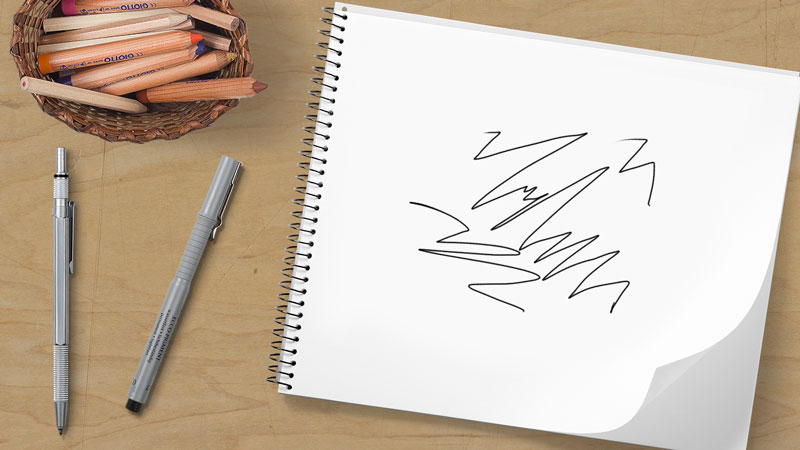
Now, let’s take a look at the “angry line”. It is likely that your “angry line” has some type of jagged mark in it. Changing directions abruptly, like in the case of a jagged line, can communicate the sense of anger. Therefore, if you are trying to communicate anger in a work, it makes sense to include jagged lines.

Lastly, let’s take a look at the “confused line”. Here we tend to see the widest variety of interpretations, but often the “confused line” will include as many different lines as the artist can imagine. It may include a curve, a jagged line, spirals, light marks and dark marks. Very simply, it will include a broad variety.

So, we can safely conclude that line is much more that a device used to indicate where an object ends. It is also expressive. And when used intelligently and creatively, it can really spice up our artwork.

Expressive line examples…

Share

Use Line To Make Your Drawings More Interesting

Posted by admin on September 6th, 2010

Use Line Drawings More InterestingDo you know how to use line effectively as an artist?  Your quick response to this question may be, “Of course, I do!”  Knowing how to use line to it’s fullest potential is important for any artist.  Line is one of the most basic elements of art.  But line can be used in conjunction with other elements such as form and the principle variety to dynamically enhance drawings and paintings.  Line quality is also called line weight, and refers to the thickness or thinness of a line.   When line quality is used in a drawing, the object can have the illusion of form without any value.  Deciding where to make the line thicker can be a little tricky.  Making the line thicker where the object gets thicker can produce this illusion.   I also like to make the line a little thicker close to where a cast shadow may be under the object.  By using line quality, you are also naturally creating variety in your artwork.

Many people understand the concept of cross contour lines, yet many people don’t actually know how to use them to make their artwork better.  Cross contour lines give us information about the form of the object.  They also help us make decisions about the direction that we should make our brush strokes when painting.  Knowing how to use cross contour lines can lead to more successful artwork.    To learn more about line quality, cross contour lines, and to see the video art lesson click here-> Line Quality Cross Contour Lines

Share

Copyright © 2012 TheVirtualInstructor Blog. TheVirtualInstructor.com Blog.