Color Wheel Chart for Values

Posted by admin on November 12th, 2011

Blog PostKnowing where colors are found on the color wheel is just one step to understanding color theory.  You must also understand practical applications of using color theory in your artworks and designs.  Seldom are colors used as their pure hue.  Most often, color combinations or color schemes, implore a variety of values and intensities of the colors used.  For example, if you were to use a complementary color scheme of red and green, you might use pink and a darker green.  Pink, you’ll recall is really the color red- a tint of red.    It seems that beginning artists really struggle with this concept.  It is hard for them to separate color and value. And understand that although related, color and value are different.  I found a great video that describes not only the basics of color theory, but also a clear explanation on how light affects the values of the colors that we perceive…

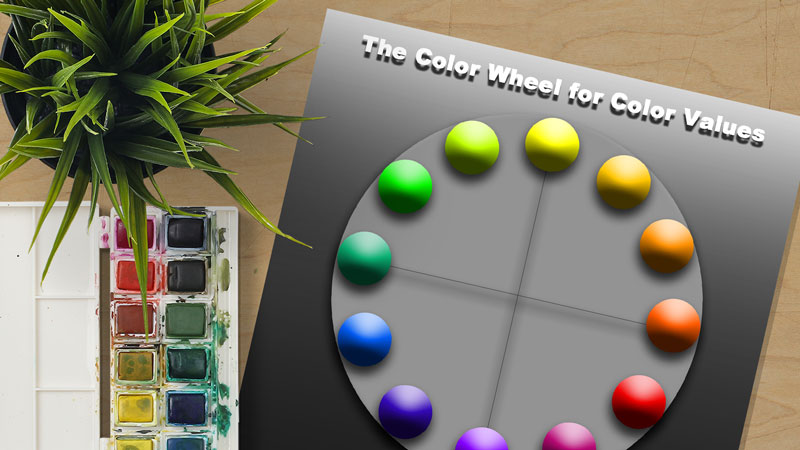
To better help my students understand the relationship between color and value, I decided to create a color wheel chart that demonstrates different values.  I put each range of value for each specific color at it’s native location on the color wheel.  This helped the students to see the color but also understand that each color also has a range of value. To see some of the other color wheel charts I created, visit color wheel charts for teacher and students.

Color Wheel Chart for Values

Feel free to download this color wheel chart and use it for yourself or with your students.  (Just click on the image, then right click, save as.)

Share

More Fun with Complementary Colors

Posted by admin on October 18th, 2011

Blog PostA few posts ago, I shared a cool animation that showed what effect color can have on our minds.  This animation works because the colors used are complementary colors.  (You can see the animation by visiting Fun with Complementary Colors.)  Complementary colors are colors that are opposites on the color wheel.  Examples of complementary colors include blue and orange, purple and yellow, and red and green.  (To see more color schemes visit The Interactive Color Wheel )These types of color schemes are often used in sports team’s uniforms and logos because they demand instant attention.  This “eye catching” effect is achieved because of contrast.

I came across another example of how complementary colors can create a cool effect and thought I’d share it with you below.

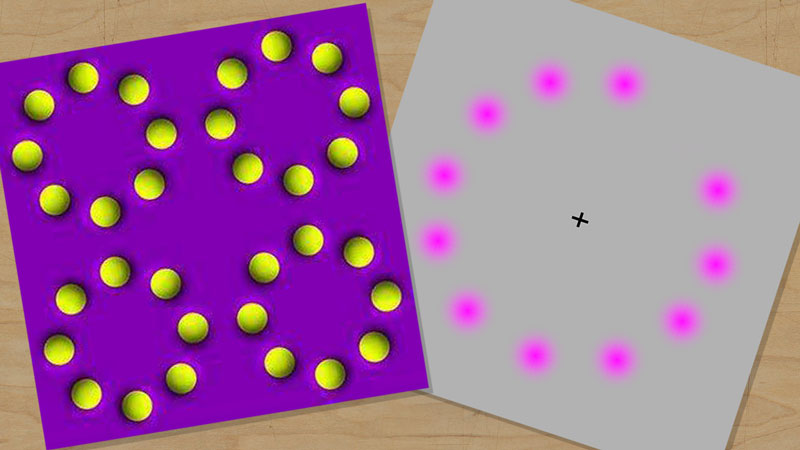
Take a look at the circles.  If you move your eye from one set of circles to another, you might notice that the circles look like they are moving.  The circles, of course, are not moving.  Instead, they appear to be moving because the colors are of a high level of contrast.  Yellow and purple are complements and this effect is achieved because of this.

Fun with complementary colors 2

Color is such a strong tool.  Use it wisely!

Share

Fun with Complementary Colors

Posted by admin on August 8th, 2011

Blog PostComplementary colors are colors that are located directly across from each other on the color wheel.  An example of this would be the color relationship of orange and blue or red and green.  Complementary color relationships tend to be my favorite type of color scheme.   They provide the highest level of contrast among colors.

Learning about the effects of complementary colors on a viewer’s experience in a drawing  or painting is one thing.  But to actually have proof that these relationships exist and witness “the power” inherent in them is quite another thing.

Take a look at the animation below.  Stare at the black “+” in the middle.  After a few seconds, a yellow-green circle will appear to be moving around the center.  After a few more second, the red-purple circles will disappear completely leaving only a yellow-green circle moving around the center.

fun-with-complementary-colors

Now what makes this really cool is the fact that there is no yellow-green circle at all.  The red-purple circles are just disappearing in a sequence.  Your mind creates the yellow-green circle.  Why yellow-green?  Well, yellow-green is the complement of red-purple.  If you take a look at a color wheel chart, you will see that yellow-green and red-purple are directly across from each other on the color wheel.  What’s even more interesting is that this works for any complementary color scheme.  For example, if you changed the red-purple circles to blue, an orange circle would appear.  If you changed the red-purple circles to yellow, a purple circle would appear.

Share

Color Wheel Chart for Teachers and Students

Posted by admin on June 27th, 2011

Blog PostFinding the right color wheel chart can be a daunting task. There are literally hundreds of thousands of color wheel charts out there. Most of which are never quite what you need for the art lesson. Part of the issue with the ever growing number of color wheels out there is that there are varied ideas when it comes to color theory in general. Most of us agree that there are 3 Primary colors: Blue, Red and Yellow; and 3 secondary colors: orange, green, and purple. Most of us can also agree that the complementary colors exist as opposites on the color wheel. This means that orange is the complement of blue; purple is the complement of yellow; and green is the complement of red.

There are Different Color Wheel Charts!

I came across a site the other day that took color theory to another level. Honestly, it made me wonder if I really knew anything about color at all. You can visit this page and read for yourself. The argument here is that the color wheels that we have been using for years are wrong. The author of the site argues that red, blue, and yellow are not the true primaries. He states that the true primaries consist of cyan, magenta, and yellow. (I have seen color theory taught this way) The arguments presented are fairly convincing. However, using this color wheel would force the complement of blue(ultramarine) to be yellow. I have a hard time swallowing that one. It does however show cobalt blue to complement orange. I guess that helps. It’s worth mentioning this theory because the color wheels charts that I’m sharing today are in the traditional vein.

(You are free to download any of the color wheel charts below…click on the image-then right click and “save as”)

Anyhow, I decided that I would create a series of color wheel charts that teachers, students, artists-whoever can use that may fulfill a specific need. Either to teach basic color mixing, complements, and so on.

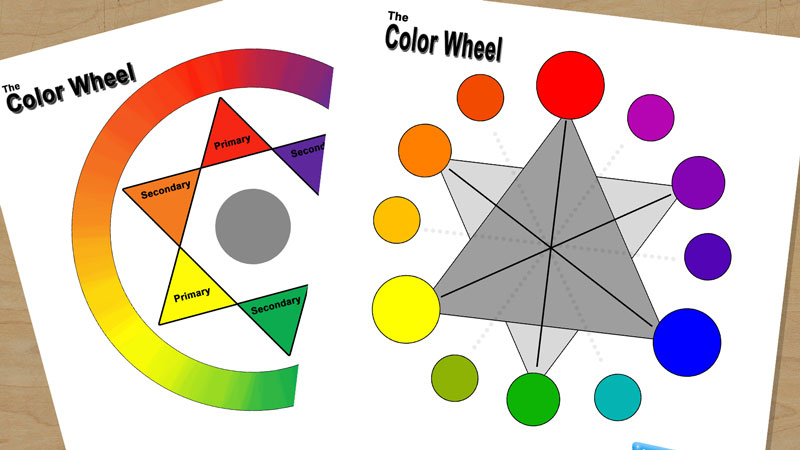
The first color wheel chart I created is intended for teaching basic color mixing. It includes a gradation of hue around the color wheel with labeled primary and secondary colors.

Color-Wheel-Chart-1

Color Wheel Chart for Color Mixing


The second color wheel chart that I created is intended to help students recognize complementary colors on the color wheel

Color-Wheel-Chart-2

Color Wheel Chart for Complementary Colors


I plan on adding new color wheel charts in future posts according to specific usage. Hopefully, some of you will find them useful and helpful to you.

I also want to share with you some color theory worksheets that I use to teach color theory to my beginner classes. Students mix paints and paint directly on the sheets. To download these sheets, click on the thumbnail-right click on the image and click “save as”

Color Wheel Chart WorksheetColor Theory Page 2 SchemesColor Theory Worksheet 3- Values

If you are looking for an interactive experience when it comes to the color wheel, try The Interactive Color Wheel.

Share

Teach Color Theory with the Interactive Color Wheel

Posted by admin on January 25th, 2011

Blog PostColor theory is an important part of creating any artworks that include color.  It is important in painting, drawing, design and sculpture.  It is equally important that all students of art learn the basics of color theory.  I think most of us agree that choosing colors for a composition should never be guesswork.  Instead, a color combination should be well planned and executed.  This can only happen by having a good understanding of the basics of color theory.   I personally think that color theory is cool.  The way that the color wheel fits together like a puzzle is just cool.  Imparting that “coolness” to students and getting them excited about color theory can be difficult.  Color theory, when not presented in an exciting way, can be boring-not to mention confusing.  Over the years, I have experimented with different ways to teach color theory to students.  I also observed the way other teachers teach the concepts of color theory to their students.  Our students, or well maybe my students, are engaged in learning most when they can interact with the concepts that I’m trying to teach to them.  Sure, mixing colors with paint, and filling in a color wheel is interactive.  This is an activity that all students should participate in.  I’m not suggesting that this activity be scratched.  But I felt like my students needed a tool that would answer their questions about the basics of color theory in a more immediate way, something that they could could interact with.  A tool that they could have access to, and that would reinforce the traditional concepts that I taught them.  I searched for some color wheels on the internet and wasn’t satisfied with the results, so I decided to make my own.  So here it is, an interactive color wheel that students can access on a classroom computer.  It gives basic information about color theory as well as information about each color.  It breaks down the complementary color of each color, the immediate analogous colors, the split complements, a color triad, and a color tetrad.  It also explains the different types of colors on the color wheel and the role of the neutral colors.  I hope that you find useful for yourself as an artist or for your students.  Find the Interactive Color Wheel Here
Interactive Color Wheel

Share

Lesson on Using Complementary Colors to Create Natural Shadow

Posted by admin on July 13th, 2010

Using Complementary ColorsComplementary colors are colors that are located directly across from each other on the color wheel.  Color relationships or color schemes are just one small part of color theory in general.  (To learn more about color theory visit here-> Color Theory) Using color schemes in a design, like for example a logo is pretty straight forward.  Color theory in representational artwork, however can be a little more challenging.   One way to use color theory, specifically complementary colors, in representational artwork is to consider highlights and shadows.  Highlights and shadows  define the illusion of the form.  When we are creating drawings or paintings, we are dealing with illusions.  Light is defined by the position of the highlights and the shadows. In turn, the highlights and shadows define the form, completing the illusion.  Highlights and shadows are opposites.  Complementary colors are also opposites.  If we include complementary colors in the highlights and shadows of our drawings and paintings, we not only add contrast, but we also add color interest.  This  increases the visual appeal of our artwork.

You can add the fact that shadows are naturally  blue in hue, and that the actual colors of the object matter (local color).  This means that one could argue that highlights and shadows are actually a blend of blue, local color, and complementary colors.  Try it out in your paintings and drawings and see if you notice a difference.  Work in layers to create a blue shadow, layered local color, and intensify it with complementary colors.

To learn more about using complementary colors to create visually stimulating highlights and shadows and to see the video demonstration click here-> How to Use Color Theory in Highlights and Shadows

Share

Copyright © 2012 TheVirtualInstructor Blog. TheVirtualInstructor.com Blog.